


Bottles and jars for takeaway sales and events
Why the right packaging is crucial
Takeaway sales have long since developed from an emergency solution into a firmly established source of revenue in the hospitality and event business. Whether takeaway drinks, prepared BBQ sauces, fine foods in jars or complete catering concepts – the right packaging has a direct impact on:
- Product presentation and brand perception
- Product quality and shelf life
- Hygiene and food safety
- Handling for your team and your guests
- Logistics, storage and costing
In this guide we show you, in practical terms, what to look for when choosing bottles for lemonades, iced teas and cocktails, and jars for sauces, dips and fine foods – including tips on closures, transport and presentation.
Bottles for lemonades, iced teas and cocktails
Key requirements for beverage bottles in B2B
For hospitality businesses, bars, caterers and events, beverage bottles are far more than just containers:
- They must look convincing and match your concept.
- They should be easy to stack and transport.
- They need to withstand hot-filling where required (for example syrups, tea extracts).
- Closures must be tight, food-safe and easy to handle.
- Ideally, they support returnable or deposit schemes.
Materials: why glass is usually the best choice for lemonades & co.
For high-quality lemonades, iced teas, syrups and cocktails, glass is usually the first choice in a B2B context:
- Neutral in taste: there is no interaction with the contents.
- High-quality appearance: particularly important for premium drinks and cocktails.
- Easy to clean (for returnable concepts) and recyclable.
- Heat and cold resistant: depending on the product, also suitable for hot-filling.
Plastic can offer advantages in terms of weight in the event sector but often looks less high quality and is usually at a disadvantage for hot-filling or longer storage.
Bottle shapes and sizes: which types are suitable for what?
Depending on how you use them, we recommend different bottle types:
Ideal for:
- Lemonades, spritzers, craft drinks
- Pre-mixed cocktails (for example Moscow Mule, gin and tonic, spritz variations)
- Homemade iced teas
Advantages:
- A familiar shape for guests, high acceptance.
- Very suitable for selling individual bottles.
- Can be closed with crown caps or screw caps.
Bulbous lemonade and juice bottles
Ideal for:
- Premium lemonades, homemade syrups, infused water
- Juices and juice blends for breakfast or conference catering
- Sharing formats (for example 0.75–1.0 l for the table)
Advantages:
- Large labelling area for branding.
- Looks high quality and is a real eye-catcher on the table.
- Practical for family and group tables.
Ideal for:
- Syrup shots, pre-mixed spirits or aperitifs
- Trial sizes and tasting sets
- Promotions at events or as an add-on
Advantages:
- Perfect for sampling and additional sales.
- Low risk when testing new products.
Colour and protection: clear, green or amber glass?
Depending on the product, not only the shape but also the glass colour is important:
- Clear glass: ideal when the colour of the drink is a selling point (for example lemonades, iced teas, colourful cocktails).
- Amber or green glass: offers better light protection for sensitive products (for example drinks with natural flavours, cold-pressed juices, kombucha).
Practical tip:
For short-lived products in fast-moving event business (for example lemonades prepared on site), appearance takes priority – here clear glass is often the right choice. For products with a longer shelf life or sensitive ingredients, amber or green glass is worth considering.
Neck finish and closure compatibility
Make sure that the neck finish and closure are compatible – and that they fit your serving concept:
- Standard screw necks (for example PP 28, PP 31.5) – well suited to lemonades, juices, iced teas.
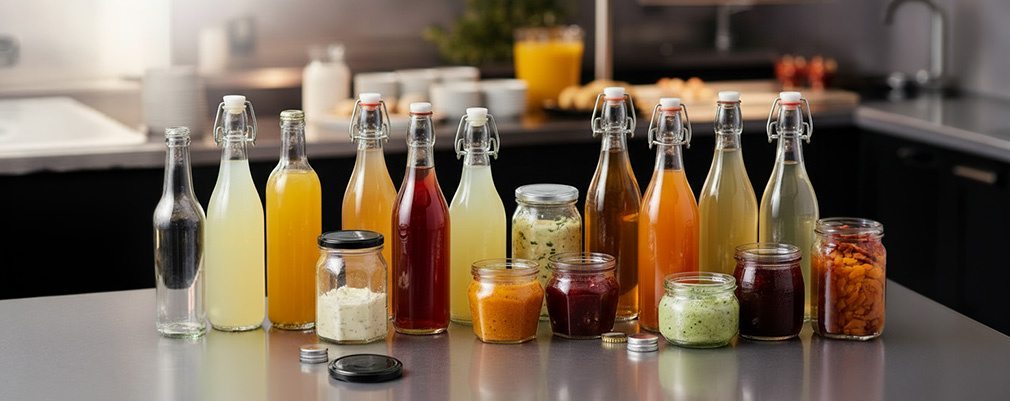
- Swing top bottles – ideal for a rustic, natural look (for example homemade lemonades, iced teas or house beer concepts).
- Crown cap bottles – classic for beer, craft drinks and many lemonades.
Plan from the outset which filling technology you will use (manual, semi-automatic, fully automatic) and whether the guest will drink directly from the bottle or be served the drink at the table in a glass.
Jars for sauces, dips and fine foods in takeaway sales
Requirements for jars for BBQ and fine foods
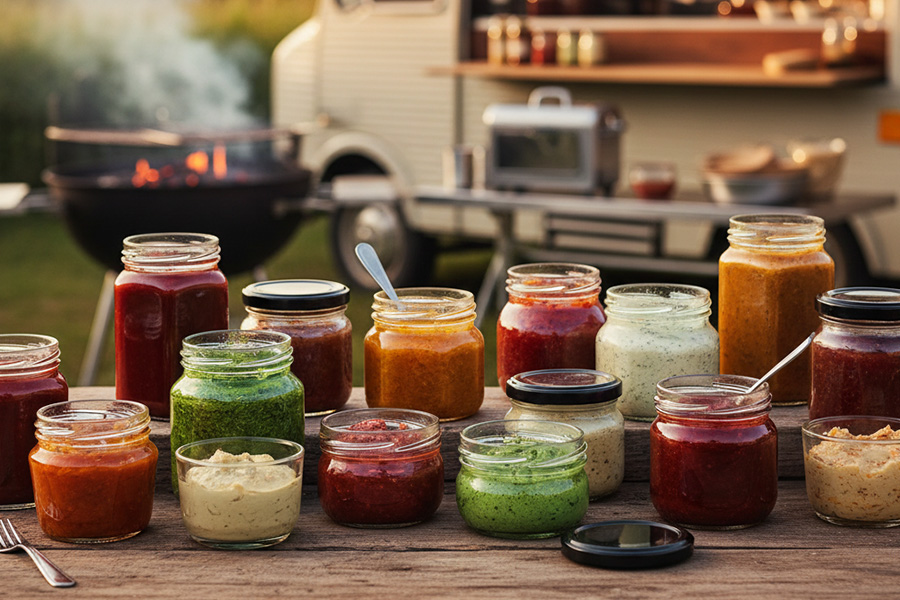
For sauces, dips, chutneys and fine foods, the basic B2B requirements are similar to those for drinks – with a few particularities:
- Hot-filling and pasteurisation must be possible (depending on the recipe).
- Jars should be easy to empty (cylindrical jars, wide openings).
- They must be stable in transport and stackable.
- The look should match your concept (BBQ, deli, fine dining, street food etc.).
Suitable jar shapes
Cylindrical jars
Cylindrical jars have straight sides and a wide opening.
Ideal for:
- BBQ sauces and ketchups
- Dips (aioli, sour cream, guacamole variations)
- Chutneys, relishes, bread spreads
Advantages:
- Contents are easy to remove, even with a spoon or spatula.
- Hot-filling and turning upside down (to briefly extend shelf life) are easily possible.
- Stackable and storage friendly.
Ideal for:
- Fine foods with a premium claim
- Gift and merchandising items
- Specialities such as truffle creams, chutneys, unusual sauces
Advantages:
- High visibility on the shelf – interesting for farm shops, delicatessens, hotel shops.
- Provide space for aesthetic labels and a strong brand presence.
Ideal for:
- Individual portions (breakfast, menu accompaniments, hotel, catering)
- Sample sizes, tasting packs or dégustation menus
Advantages:
- Perfect for portion control and costing.
- Allow you to test new products with low risk.
Size and portion planning
Choose jar sizes that match your portion logic:
- BBQ sauce for retail: for example 200–350 ml per jar.
- Premium dips for catering: for example 80–150 ml per unit.
- Breakfast portions (jam, spreads): 30–50 ml.
Practical tip:
Start with one or two clearly defined standard sizes that match your menu. This avoids complex stock-keeping and makes costing easier.
Closures: tight, safe and in line with your concept
The best bottles and jars are of little use if the closure is not suitable. Pay attention to tightness, handling and appearance.
Screw caps and twist-off lids
- Screw caps are standard on many jars (twist-off) and bottles.
- Suitable for hot-filling and pasteurisation (depending on the closure type).
- Available in different colours and materials – important for your brand image.
Areas of use:
- Jars for sauces, dips and fine foods
- Juice and lemonade bottles
- Syrups and concentrates
Swing top closures
- Swing top closures create a distinctive, handcrafted look.
- Reclosable without additional tools.
- Ideal for repeat customers and returnable concepts.
Areas of use:
- Homemade lemonades and iced teas
- Syrups and essences
- Beer and craft beverages
Crown caps
- Crown caps are classics for beer, craft drinks and many lemonades.
- Very tight and safe but cannot be opened without a tool.
- Better suited to products that reach the guest as a “finished product“ in the bottle.
Areas of use:
- Bottles for bars, festivals, street food events
- Special drinks for retail or your own direct sales
Special closures and dispensers
Depending on your concept, additional closures can be useful:
- Grip stoppers in an elegant wood look for reclosable bottles
- Pourers for syrups and dressings (bar and catering)
- Dispenser or pump closures for high-traffic stations (buffet, coffee or cocktail stations)
Practical tip:
Plan closures together with your production and service workflow: how often will they be opened and closed? Who operates the closure – your team or the guest? How important is a visible freshness seal?
Transport and logistics: getting your products safely to their destination
Outer packaging units and warehouse logistics
When choosing products, pay attention to:
- Outer packaging units that match your consumption (for example cartons of 20, 40 or more pieces).
- Stackable cartons and a secure pallet layout.
- Clear labelling (contents, batch, best-before date) to simplify warehouse processes.
A well-structured storage area reduces breakage, search times and stock shortages.
Breakage safety and handling at events
Especially in the event and catering sector, breakage safety plays a major role:
- For transport: use sturdy cartons, and dividers or bottle crates if necessary.
- When serving: plan enough collection points for empties.
- In takeaway sales: consider customer-friendly carrying solutions (for example carriers for several bottles).
Practical tip:
Before larger events, run a realistic test: how many bottles/jars can staff or guests carry at once? Where do bottlenecks arise? Simple aids (crates, trays, carriers) can often reduce breakage and stress significantly.
Cooling and temperature control
For drinks and sensitive fine foods:
- Plan sufficient cooling capacity before, during and after transport.
- Use darker glass colours or additional packaging if products cannot be kept chilled at all times and are sensitive to light.
- Communicate clearly on the label: “Store chilled“ / “Once opened, keep refrigerated and consume within X days“.
Presentation and brand presence: turning bottles and jars into sales drivers
Labels and branding
Bottles and jars are small brandambassadors. Pay attention to:
- Consistent design (colours, fonts, logo, visual style).
- Clearly legible information: product name, main ingredients, fill volume, allergens, storage notes.
- Professional-looking labels applied cleanly (not crooked, no bubbles).
The higher the quality of your products, the more the look of the packaging influences your guests’ or customers’ willingness to pay.
Presentation on site and at events
Think about how your bottles and jars will be showcased in day-to-day use:
- Drinks stations and buffets: uniform bottle rows with clearly visible product names.
- Counter presentation: place selected products in a prominent position (for example fine food jars at the point of sale).
- Event bars and food trucks: open shelves with visible bottles increase attention.
Practical tip:
Use selected display pieces (for example two or three particularly attractive bottles and jars) very deliberately as eye-catchers – for instance on the counter or at the start of the buffet.
Returnable and deposit schemes
Many B2B customers are increasingly focusing on sustainable concepts:
- Robust bottles and jars are well suited to returnable systems or deposit schemes.
- Communicate clearly how returns and cleaning work.
- Choose shapes that are stackable, suitable for crates and able to withstand many cycles of use.
How to find the right solution for your business
Before you decide on specific bottles and jars, these guiding questions will help:
- Which products do I want to offer in takeaway sales or at events (drinks, sauces, fine foods, combinations)?
- How will the products be used? Consumed straight away, taken away, sold as gifts, resold in retail?
- Which fill volumes make sense for my guests/customers and are viable from a costing perspective?
- What does my logistics set-up look like? How much storage space, how much staff, which transport routes?
- Which brand image do I want to convey (rustic, modern, premium, sustainable)?
Once you have answered these questions, you can choose bottles, jars and closures that fit your concept – and set up your takeaway sales and events on a professional and economically sound basis.
Conclusion: bottles and jars as success factors in takeaway business
The right packaging is a real success factor in takeaway sales and in the event business:
- It protects your products and safeguards their quality.
- It makes processes easier for your team.
- It increases the perceived value and willingness to pay of your guests.
- It carries your brand – far beyond your venue or event.
With carefully selected bottles, jars and closures that are tailored to your offer, you create the basis for satisfied customers, smooth workflows and solid additional sales in takeaway business and at your events.
Our recommendations for hospitality & events


Available immediately. Ready for dispatch in: 1-2 days


Available immediately. Ready for dispatch in: 1-2 days


Available immediately. Ready for dispatch in: 1-2 days


Available immediately. Ready for dispatch in: 1-2 days


Available immediately. Ready for dispatch in: 1-2 days


Available immediately. Ready for dispatch in: 1-2 days


Available immediately. Ready for dispatch in: 1-2 days


Available immediately. Ready for dispatch in: 1-2 days


Available immediately. Ready for dispatch in: 1-2 days


Available immediately. Ready for dispatch in: 1-2 days