


Preserving food with twist-off jars
Twist-off jars are a popular choice for home preserving. Whether you want to store whole fruits, sauces, or meat dishes, the possibilities are endless. Here, we’ll guide you through the different preservation methods and highlight what you should keep in mind when using Twist-off jars.
What are twist-off jars?
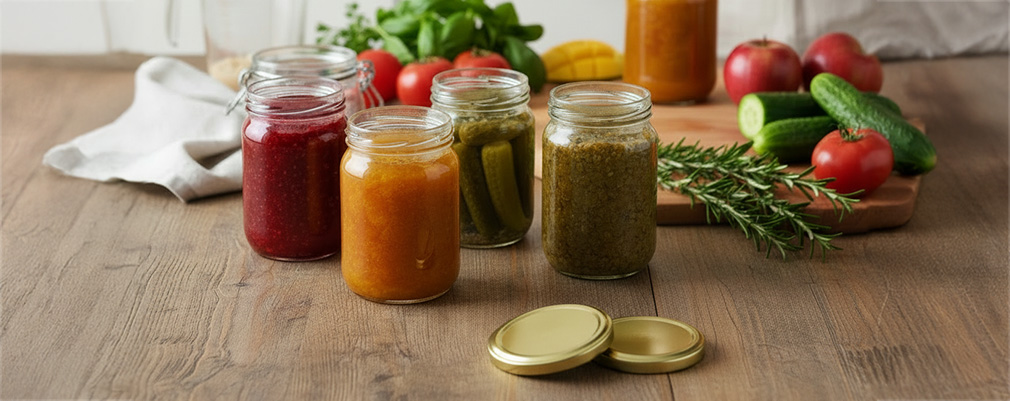
Twist-off jars are often equated with screw-top jars, but there are some differences. Rather than a continuous screw thread, Twist-off jars feature several small ridges or lugs. The Twist-off lid is fitted with small protrusions, known as cams, which grip the ridges, securing the lid with just a quarter turn. This type of lid is also called a cam screw cap.
Like traditional screw caps, Twist-off lids can be resealed after opening. They are typically made from lacquered tinplate or plastic, with a firm rubber seal (compound) inside.
Are all twist-off jars suitable for preserving?
If the Twist-off jars are heat-resistant, you can use them for preserving without any trouble. However, there are differences in the lids: Pasteurisation-grade Twist-off lids usually withstand temperatures up to around 100°C. Sterilisable Twist-off lids have a firmer seal and are suitable for higher temperatures. Always check the product description for the relevant information.
What can you preserve in twist-off jars?
Twist-off jars are true all-rounders. They are especially popular for hot-filling jams, preserves, compotes, jellies, and chutneys. But they are also suitable for pickling and preserving a variety of foods. Commonly preserved fruits and vegetables include:
- Apples
- Pears
- Apricots
- Plums
- Cherries
- Strawberries
- Cucumbers
- Carrots
- Tomatoes
- Kohlrabi
- Courgettes
Instead of whole or sliced fruit, you can also preserve purees such as apple sauce or blackcurrant puree. Sauces and complete dishes like goulash, soups, and stews are also well-suited to Twist-off jars. Meats, sausages, and spreads are often stored in straight-sided Twist-off jars, which make it easy to remove the contents.
Important: If you plan to preserve oily foods, ensure that your Twist-off lids are suitable for this purpose.
How does preserving with twist-off jars work?
There are several ways to preserve food using Twist-off jars. One great advantage is that you don’t need any extra equipment like preserving clips or rubber seals.
The basic principle is to fill the jars and then heat them in a water bath or with steam. It’s important that the water is at roughly the same temperature as the contents of the jars to begin with. Only once the jars are in the water should you bring it to the boil. The heat kills off any bacteria or microorganisms.
Unlike classic screw lids, Twist-off lids sit quite loosely on the jar, allowing air to escape as pressure builds during the heating process. Nothing can get in from the outside, though. As the jars cool, a vacuum forms, sealing the jar airtight.
How to preserve in twist-off jars: Step-by-step
Below you’ll find some basic instructions for preserving with Twist-off jars using different methods. Times and temperatures vary depending on the product, so we don’t give specific figures here. Beginners should always use tried-and-tested recipes, which may differ from these general instructions.
Preserving in a saucepan
- Place a rack or a tea towel in the bottom of your pan before adding the filled jars. The jars should not touch the base.
- Add enough water to cover the jars by about three-quarters.
- Put the lid on the pan and heat the water. Once the required temperature is reached, start timing the process. Use a preserving thermometer to check the temperature.
- After preserving, turn off the hob and leave the jars in the water for a few more minutes.
- Finally, place the jars on a tea towel to cool. Tongs or a jar lifter can be helpful here.
Preserving in a pressure cooker
For pressure cookers, use Twist-off jars with sterilisable lids, as these seals can withstand the pressure. This method is less common in Germany, so recipes are rare. Ideally, your pressure cooker manual will include instructions.
- Prepare the jars as for the saucepan method, but use less water, as the steam is retained.
- Place the jars in the water, close the cooker, and set the required pressure.
- The preserving time begins once the target temperature is reached; the cooker’s valve usually indicates this.
- At the end of the cooking time, leave the jars in the closed cooker. Opening it too soon can cause the contents to spill out.
- Open the cooker only once all the pressure has been released, then remove the jars and allow them to cool.
Preserving in an electric preserving machine
Electric preserving machines make preserving particularly easy, as you can set the temperature and time precisely.
- Prepare the jars as you would for the saucepan method.
- After closing the machine, set the time and temperature.
- Remove the jars once the process is complete.
Preserving with a steam oven
Steam ovens preserve food using only steam.
- Fill the water tank if necessary.
- Place the jars on a perforated tray on the lowest shelf, with some space between them.
- Set the time and temperature as with the preserving machine.
- After the time is up, switch off the oven.
- Leave the jars to cool in the oven for about an hour before removing and covering them with a kitchen towel.
Preserving in the oven with twist-off jars
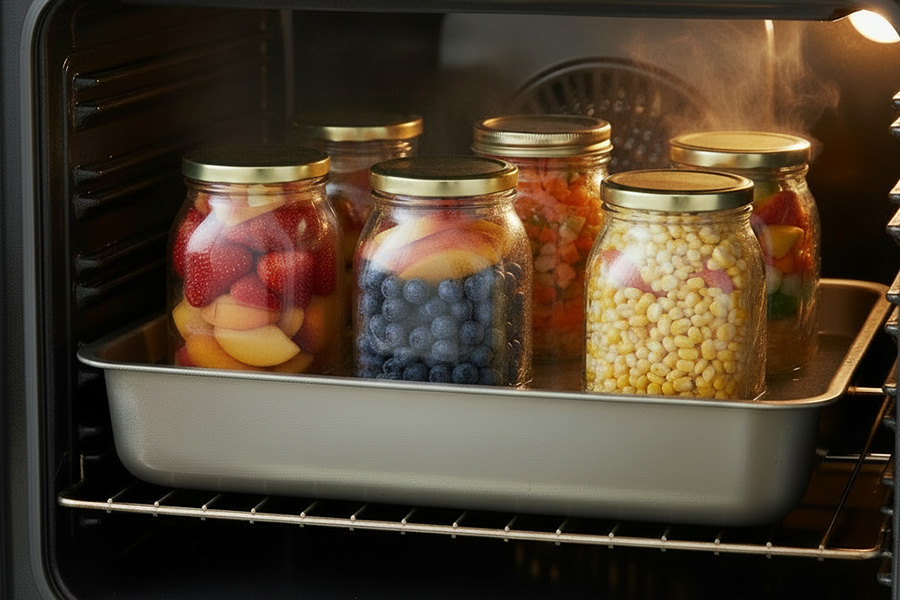
You can also preserve in Twist-off jars using your oven:
- Place the filled jars in a roasting tin on the lowest shelf of the oven. Add enough water so the jars stand in about 3 cm of water.
- Make sure the jars don’t touch each other.
- Switch on the oven and set the required temperature.
- Once bubbles start to rise inside the jars, the preserving time begins. You may need to reduce the temperature at this point.
- When the time is up, turn off the oven and leave the jars to cool inside.
Preserving in the microwave
Small quantities of fruit and vegetables can be preserved in the microwave. Only use microwave-safe Twist-off jars, or you risk a fire!
- Place the filled jars in a dish to catch any liquid that might escape.
- Heat the jars on full power for a few minutes.
- After the process, leave the jars in the microwave for a short while before removing them.
What should you keep in mind when preserving?
To ensure successful preservation, remember the following:
- Jars and lids must be undamaged.
- Only use fresh, clean ingredients.
- Cleanliness is crucial: Sterilise the jars before use, and make sure no residue is left on the rim or lid. A funnel can help.
- Do not fill jars to the brim—leave a few centimetres of space.
- Avoid overtightening the lids, as this can prevent a proper seal.
- The preserving temperature should be at least 80°C.
- For safety, preserve meat and vegetables twice to prevent botulism.
- Store preserved food away from direct sunlight and high temperatures, as colour, texture, or even edibility may be affected. A dry cellar or pantry is ideal.
Sterilising twist-off jars
Before filling with food, sterilise your jars and lids by boiling them in water for about ten minutes. Let them dry on a clean kitchen towel.
After preserving: Checking the seal
Even if you follow every tip and recipe, sometimes preservation doesn’t succeed. Once cooled, check your jars: a vacuum has formed if the centre of the lid is concave. Later, when you open the jar, a popping sound indicates the contents are safely preserved.
Don’t forget to label!
Whether you plan to sell, gift, or enjoy your preserves yourself, always label your jars. At World of bottles, we offer labels in various designs, perfect for noting the product name, ingredients, and production or best-before date.
Can you reuse twist-off jars?
Twist-off jars can be reused without any problems and are usually dishwasher-safe. Lids are not designed for repeated use, but you can reuse them if:
- They are undamaged and not misshapen,
- The sealing compound is intact,
- There are no rust spots or persistent stains.
Bear in mind that reusing lids increases the risk that a vacuum may not form.
Order twist-off jars for preserving online
At World of bottles, you’ll find a wide range of Twist-off jars in various shapes and sizes at affordable prices. We supply both businesses and private customers, with no minimum order quantity.
You’ll also find replacement lids and accessories such as decorative fabric covers in our online shop. Of course, we also stock other types of preserving jars, such as clip-top jars and classic WECK jars with glass lids and rubber seals. We can even print jars and bottles with your design from a low minimum quantity.
Accessories for preserving with twist-off jars in the World of bottles shop


Available immediately. Ready for dispatch in: 1-2 days


Available immediately. Ready for dispatch in: 1-2 days

Available immediately. Ready for dispatch in: 1-2 days


Available immediately. Ready for dispatch in: 1-2 days


Available immediately. Ready for dispatch in: 1-2 days


Available immediately. Ready for dispatch in: 1-2 days

Available immediately. Ready for dispatch in: 1-2 days

Available immediately. Ready for dispatch in: 1-2 days

Available immediately. Ready for dispatch in: 1-2 days

Available immediately. Ready for dispatch in: 1-2 days